What helped the Chinese to overthrow the Mongol rulers?
| Mongol conquest of Mainland china | |||||||||
|---|---|---|---|---|---|---|---|---|---|
| Office of the Mongol invasions and conquests | |||||||||
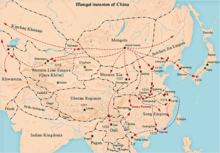 Mongol conquest of Chinese regimes | |||||||||
| |||||||||
| Belligerents | |||||||||
| Mongol Empire/Yuan dynasty
Southern Song dynasty (1211–1234)  Goryeo (1218-1219) Goryeo (1218-1219) | Western Xia (1205–1210, 1225–1227) | ||||||||
| Commanders and leaders | |||||||||
| Genghis Khan (possibly † ) Jebe Muqali Boal (Bor) Doqolqu Tolui Ögedei Subutai Chagaan Kublai Khan Khochu Töregene Güyük Khan Möngke Khan (possibly † ) Bayan Aju Arikhgiya Full general Shi Tianze General Zhang Hongfan General Zhang Rou General Yan Shi General Liu Heima (Liu Ni) General Xiao Zhala General Uryankhadai General Guo Kan King Duan Xingzhi of Dali | Emperor Huanzong Emperor Li Anquan Kao Liang-Hui Wei-ming Ling-kung Wanyan Yongji † Emperor Xuanzong of Jin † Li Ying Moran Jinzhong Emperor Aizong of Jin † Wanyan Heda Puxian Wannu Pucha Guannu Ma Yong Emperor Mo of Jin † Emperor Xianzong Emperor Mozhu  (1226–1227) Asha King Duan Xingzhi of Dali (defected to Mongols) Emperor Lizong Emperor Duzong Emperor Gong of Vocal Emperor Duanzong Emperor Bing of Song † Jia Sidao Lü Wenhuan Li Tingzhi Zhang Shijie Wen Tianxiang | ||||||||

The Mongol conquest of China was a series of major military efforts by the Mongol Empire to conquer various empires ruling over Prc. It spanned six decades in the 13th century and involved the defeat of the Jin dynasty, Western Liao, Western Xia, Tibet, the Dali Kingdom, the Southern Vocal, and the Eastern Xia. The Mongol Empire under Genghis Khan started the conquest with pocket-size-scale raids into Western Xia in 1205 and 1207.[one]
By 1279, the Mongol ruler Kublai Khan had established the Yuan dynasty in Red china and crushed the last Vocal resistance, which marked the onset of all of China under Yuan dominion. This was the offset fourth dimension in history that the whole of Mainland china was unified by non-Han people, and information technology marked the first time in history when Tibet was unified with the rest of Red china.[2]
Conquest of Western Xia [edit]
In the early 1200s, Temujin, shortly to be Genghis Khan, began consolidating his power in Mongolia. Following the expiry of the Kerait leader Ong Khan to Temujin's emerging Mongol Empire in 1203, Kerait leader Nilqa Senggum led a small ring of followers into Western Xia, also known as Eleven-Xia.[iii] However, after his adherents took to plundering the locals, Nilqa Senggum was expelled from Western Xia territory.[three]
Using his rival Nilga Senggum's temporary refuge in Western Xia equally a pretext, Temujin launched a raid against the state in 1205 in the Edsin region.[three] [4] [5] The Mongols plundered edge settlements and 1 local Western Xia noble accepted Mongol supremacy.[6] The next twelvemonth, 1206, Temujin was formally proclaimed Genghis Khan, ruler of all the Mongols, mark the official outset of the Mongol Empire. In 1207, Genghis led some other raid into Western Xia, invading the Ordo region and sacking Wuhai, the chief garrison along the Yellowish River, earlier withdrawing in 1208.[5] [7]
In 1209, the Genghis undertook a larger campaign to secure the submission of Western Xia. Afterward defeating a force led past Kao Liang-Hui outside Wuhai, Genghis captured the city and pushed upward along the Yellowish River, defeated several cities, and besieged the capital, Yinchuan, which held a well-fortified garrison of 150,000.[eight] The Mongols, at this point inexperienced at siege warfare, attempted to flood out the city by diverting the Yellow River, but the dike they built to accomplish this broke and flooded the Mongol army camp.[3] Nevertheless, Emperor Li Anquan, still threatened past the Mongols and receiving no relief from the Jin dynasty, surrendered to the Mongol and demonstrated his loyalty by giving a daughter, Chaka, in marriage to Genghis and paying a tribute of camels, falcons, and textiles.[nine]
Later on their defeat in 1210, Western Xia served as faithful vassals to the Mongol Empire for almost a decade, aiding the Mongols in their state of war against the Jin dynasty. In 1219, Genghis Khan launched his campaign against the Khwarazmian dynasty in Primal Asia, and requested military aid from Western Xia. Nevertheless, the emperor and his military commander Asha refused to take part in the campaign, stating that if Genghis had as well few troops to attack Khwarazm, so he had no claim to supreme power.[10] [11] Infuriated, Genghis swore vengeance and left to invade Khwarazm, while Western Xia attempted alliances with the Jin and Song dynasties against the Mongols.[12]
After defeating Khwarazm in 1221, Genghis prepared his armies to punish Western Xia for their betrayal, and in 1225 he attacked with a force of approximately 180,000.[13] After taking Khara-Khoto, the Mongols began a steady advance southward. Asha, commander of the Western Xia troops, could not afford to meet the Mongols equally information technology would involve an exhausting westward march from the capital Yinchuan through 500 kilometers of desert, and so the Mongols steadily advanced from city to city.[14] Enraged past Western Xia's fierce resistance, Genghis engaged the countryside in annihilative warfare and ordered his generals to systematically destroy cities and garrisons equally they went.[ten] [12] [fifteen] Genghis divided his army and sent full general Subutai to take care of the westernmost cities, while the main force under Genghis moved eastward into the centre of the Western Xia Empire and took Ganzhou, which was spared destruction upon its capture due to it being the hometown of Genghis'south commander Chagaan.[16]
In August 1226, Mongol troops approached Wuwei, the 2d-largest city of the Western Xia empire, which surrendered without resistance in gild to escape destruction.[17] In Autumn 1226, Genghis took Liangchow, crossed the Helan Shan desert, and in November lay siege to Lingwu, a mere xxx kilometers from Yinchuan.[18] [19] Here, in the Battle of Yellow River, the Mongols destroyed a forcefulness of 300,000 Western Xia that launched a counter-assault confronting them.[xviii] [20]
Genghis reached Yinchuan in 1227, laid siege to the city, and launched several offensives into Jin to prevent them from sending reinforcements to Western Xia, with one strength reaching every bit a far as Kaifeng, the Jin capital.[21] Yinchuan lay besieged for about six months, afterwards which Genghis opened upwardly peace negotiations while secretly planning to kill the emperor.[22] During the peace negotiations, Genghis continued his armed services operations around the Liupan mountains most Guyuan, rejected an offer of peace from the Jin, and prepared to invade them almost their border with the Song.[23] [24] Nonetheless, in August 1227, Genghis died of a historically uncertain cause, and, in order not to jeopardize the ongoing campaign, his expiry was kept a secret.[25] [26] In September 1227, Emperor Mozhu surrendered to the Mongols and was promptly executed.[24] [27] The Mongols then mercilessly pillaged Yinchuan, slaughtered the city's population, plundered the imperial tombs west of the city, and completed the effective annihilation of the Western Xia state.[12] [24] [28] [29]
Conquest of Jin dynasty [edit]

The siege of Zhongdu (modern Beijing) in 1213–14.
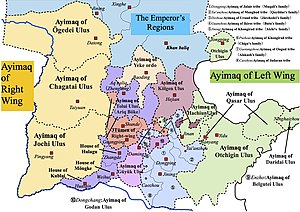
Mongol Empire'south Ayimaq in North Communist china
One of the major goals of Genghis Khan was the conquest of the Jin dynasty, allowing the Mongols to avenge the earlier expiry of a Mongol Khan, proceeds the riches of northern Cathay and to establish the Mongols as a major power in the East-Asian earth.
Genghis Khan declared war in 1211, and while Mongols were victorious in the field, they were frustrated in their efforts to accept major cities. In his typically logical and determined fashion, Genghis and his highly adult staff studied the problems of the attack of fortifications. With the help of Chinese engineers, they gradually developed the techniques to take down fortifications. This eventually would make troops under the Mongols some of the most accomplished and most successful besiegers in the history of warfare.
As a outcome of a number of overwhelming victories in the field and a few successes in the capture of fortifications deep within China, Genghis had conquered and consolidated Jin territory as far south every bit the Great Wall by 1213. Cherik soldiers were not-nomad soldiers in the Mongol military. Jin defectors and Han Chinese conscripts were recruited into new armies formed by the Mongols as they destroyed the Jin dynasty. A critical function in the defeat of the Jin was carried out past the Han Chinese cherik forces. Han Chinese defectors led past General Liu Bolin defending Tiancheng from the Jin in 1214 while Genghis Khan was busy going back n. In 1215 Xijing cruel to Liu Bolin's army. The original Han cherik forces were created in 1216 and Liu Bolin appointed as their leading officer. As Han troops kept defecting from the Jin to the Mongols the size of Han cherik forces swelled and they had to exist partitioned between different units. Han soldiers fabricated up the majority of the Khitan Yelu Tuhua's army, while Juyin soldiers from Zhongdu fabricated up Chalaer'due south army and Khitan made up Uyar'due south army. Chalaer, Yelu Tuhua and Uyar led three cherik armies in northern Cathay under the Mongol commander Muqali in addition to his tamma armies in 1217–1218.[30]
Many Han Chinese and Khitan defected to the Mongols to fight against the Jin. Two Han Chinese leaders, Shi Tianze, Liu Heima ( 劉黑馬 , Liu Ni),[31] [32] [33] [34] and the Khitan Xiao Zhala ( 蕭札剌 ) defected and commanded the 3 Tumens in the Mongol army.[35] [36] [37] [38] Liu Heima and Shi Tianze served Ogödei Khan.[39] Liu Heima and Shi Tianxiang led armies confronting Western Xia for the Mongols.[twoscore] In that location were iv Han Tumens and 3 Khitan Tumens, with each Tumen consisting of x,000 troops. The iii Khitan Generals Shimobeidier ( 石抹孛迭兒 ), Tabuyir ( 塔不已兒 ) and Xiao Zhongxi ( 蕭重喜 ) commanded the 3 Khitan Tumens and the four Han Generals Zhang Rou, Yan Shi, Shi Tianze, and Liu Heima allowable the four Han tumens nether Ogödei Khan.[41] [42] [43] [44] Shi Tianze (Shih T'ien-tse), Zhang Rou (Chang Jou, 張柔 ), and Yan Shi (Yen Shih, 嚴實 ) and other high ranking Chinese who served in the Jin dynasty and defected to the Mongols helped build the structure for the administration of the new state.[45] The Mongols received defections from Han Chinese and Khitans while the Jin were abandoned by their own Jurchen officers.[46] Interethnic marriage between Han and Jurchen became common at this time. The Han Chinese Full general Shi Tianze'south male parent Shi Bingzhi (史秉直, Shih Ping-chih) were married to a Jurchen woman[47] Shi Tianze was married to 2 Jurchen women (Mo-nien and Na-ho), a Han Chinese woman (Shi), and a Korean woman (Li), and his son Shi Gang was born to one of his Jurchen wives and the family served the Yuan prominently.[48] [47] and Shi Gang married a Kerait woman, the Kerait were Mongolified Turkic people and part of the "Mongol nation".[49] [l]
Han Chinese warlords who defected to the Mongols like Shi Bingzhi, Shi Tianze[51] and Zhou Xianchen were given the title of shihou (世侯) which meant "hereditary vassal" and given fiefs of land in northern China numbering several cities and towns every bit a sub-fief nether the Emperor'southward regions or under a bigger Mongol Ayimaq fief.[52]
Genghis avant-garde with three armies into the middle of Jin territory, between the Great Wall and the Xanthous River. With the assist of Chenyu Liu, one of the top officers who betrayed Jin, as well equally the Southern Song, who wanted revenge on Jin, Genghis defeated the Jin forces, devastated northern Red china, captured numerous cities, and in 1215 besieged, captured and sacked the Jin capital letter of Yanjing (mod-24-hour interval Beijing).
However, the Jin emperor, Xuan Zong, did not surrender, but moved his capital to Kaifeng. The city vicious in the siege of Kaifeng in 1232. Emperor Aizong fled to the town of Caizhou. Afterwards this, the Han Chinese full general Shi Tianze led troops to pursue Emperor Aizong every bit he retreated, and destroyed an 80,000-strong Jin ground forces led by Wanyan Chengyi (完顏承裔) at Pucheng (蒲城). The Jin dynasty complanate after the siege of Caizhou in 1234. Eastern Xia, an short-lived kingdom which declared independence from Jin in 1215, was conquered in 1233.
The offset Han armies in the Mongol ground forces were those led by defecting individual officers. At that place were ane,000 Han (Chinese) troops each in 26 units which made up 3 tumeds arranged by Ogedei Khan on a decimal system. The Han officeholder Shi Tianze, Han officer Liu Ni and the Khitan officer Xiao Chala, all three of whom defected to the Mongols from the Jin led these three tumeds. Chang Jung, Yen Shi and Chung Jou led three additional tumeds which were created before 1234. The Han defectors were called the "Black Army" (Hei Jun) by the Mongols before 1235. A new infantry based "New Army" (Xin Jun) was created after the Mongols received 95,000 additional Han soldiers through conscription once the 1236 and 1241 censuses were taken later on the Jin was crushed. Han cherik forces were used to fight against Li Tan's defection in 1262. The New Ground forces and Black Army had hereditary officeholder posts like the Mongol army itself.[53]
The Mongols valued physicians, craftsmen and religious clerics and ordered them to exist spared from death and brought to them when cities were taken in northern People's republic of china.[54]
Conquest of Dali Kingdom [edit]
Möngke Khan dispatched Kublai to the Dali Kingdom in 1253 to outflank the Song. The Gao family unit dominated the court, resisted and murdered Mongol envoys. The Mongols divided their forces into 3. One fly rode e into the Sichuan basin. The 2d column under Uryankhadai took a difficult way into the mountains of western Sichuan.[55] Kublai himself headed south over the grasslands, coming together up with the outset column. While Uryankhadai galloping in forth the lakeside from the north, Kublai took the capital city of Dali and spared the residents despite the slaying of his ambassadors. The Dali King Duan Xingzhi ( 段興智 ) himself defected to the Mongols, who used his troops to conquer the remainder of Yunnan. The Mongols appointed Rex Duan Xingzhi as Maharajah and stationed a pacification commissioner there.[56] After Kublai's departure, unrest broke out among the Blackness Jang (one of the main indigenous groups of the Dali kingdom). Past 1256, Uryankhadai, the son of Subutai had completely pacified Yunnan. The Duan family were originally Han Chinese from Wuwei in Gansu.
The Duan family all the same ruled Dali relatively independently during the Yuan dynasty.[57] The Ming abolished them.[58]
The Tusi chieftains and local tribe leaders and kingdoms in Yunnan, Guizhou and Sichuan submitted to Yuan rule and were allowed to proceed their titles. The Han Chinese Yang family ruling the Chiefdom of Bozhou which was recognized past the Song dynasty and Tang dynasty also received recognition by the Mongols in the Yuan dynasty and later past the Ming dynasty. The Luo clan in Shuixi led by Ahua were recognized by the Yuan emperors, as they were by the Vocal emperors when led by Pugui and Tang emperors when led by Apei. They descended from the Shu Han era male monarch Huoji who helped Zhuge Liang against Meng Huo. They were also recognized past the Ming dynasty.[59] [60]
Southwestern China [edit]
Many Tusi chiefdoms and kingdoms in southwestern China which existed before the Mongol invasions were allowed to retain their integrity equally vassals of the Yuan dynasty subsequently surrendering, including the Kingdom of Dali, the Han Chinese Yang family ruling the Chiefdom of Bozhou with its seat at the castle Hailongtun, Chiefdom of Lijiang, Chiefdom of Shuidong, Chiefdom of Sizhou, Chiefdom of Yao'an, Chiefdom of Yongning and Mu'ege. As were the Goryeo dynasty and the Kingdom of Qocho.
The Han Chinese nobles Duke Yansheng and Celestial Masters continued possessing their titles in the Yuan dynasty since the previous dynasties.
Conquest of Southern Vocal [edit]
At second, the Mongols allied with Southern Song as both had a common enemy in the form of Jin. Notwithstanding, this alliance broke down with the destruction of Jur'chen Jin in 1234. After Song forces captured the former Northern Song capitals of Luoyang, Chang'an and Kaifeng from the Mongols and the Song had killed a Mongol ambassador, the Mongols declared war on the Song. Very quickly the Mongol armies forced the Vocal back to the Yangtze, although the two sides would be engaged in a four-decade war until the fall of the Song in 1276. Islamic engineers joined later and especially contributed counterweight trebuchets, "Muslim phao", which had a maximum range of 300 meters compared to 150 meters of the ancient Chinese predecessor. Information technology played a significant function in taking the Chinese strongholds and was as well used confronting infantry units on the battleground.
The Mongol forcefulness which invaded south China was far greater than the force they sent to invade the Middle Eastward in 1256.[61]
The Mongols made heavy use of indigenous ethnic minority soldiers in southern China rather than Mongols. The Kingdom of Dali's indigenous Cuan-Bo ground forces led by the Duan royal family unit were the majority of the forces in the Mongol Yuan army sent to attack Song China during battles along the Yangtze river. During a Mongol attack against the Song China, at that place were but iii,000 Mongol cavalry at one point under the Mongol commander Uriyangkhadai, the majority of his army were native Cuan-Bo with Duan officers.[62]
While the Mongol forces had success against the non-Han Chinese ruled states of the Jin and Xia, conquering the Song took much more time. The Song forces were equipped with the all-time engineering science bachelor at the time, such as an ample supply of gunpowder weapons similar fire lances, rockets and flamethrowers. The violent resistance of the Song forces resulted in the Mongols having to fight the most difficult war in all of their conquests,[63] and the Mongols required every advantage they could gain and "every armed services artifice known at that time" in gild to win. They looked to peoples they already conquered to learn various military machine advantages.[64] Withal, intrigues at the Vocal courtroom would favor the Mongols.
The Yuan dynasty created a "Han Army" (漢軍) out of defected Jin troops and regular army of defected Song troops called the "Newly Submitted Regular army" (新附軍).[65] Southern Song Chinese troops who defected and surrendered to the Mongols were granted Korean women as wives by the Mongols, whom the Mongols earlier took during their invasion of Korea as war booty.[66] The many Song Chinese troops who defected to the Mongols were given oxen, clothes and land by Kublai Khan.[67] As prize for battleground victories, lands sectioned off as appanages were handed by the Yuan dynasty to Chinese military officers who defected to the Mongol side. The Yuan gave Song Chinese soldiers who defected to the Mongols juntun, a type of armed forces farmland.[68] Chagaan (Tsagaan) and Han tumen General Zhang Rou jointly launched an set on on the Song dynasty ordered by Töregene Khatun.
After several indecisive wars, the Mongols unsuccessfully attacked the Song garrison at Diaoyu Fortress Hechuan when their Great Khan, Möngke, died of cholera or dysentery. However, the general responsible for this defence was not rewarded simply instead was punished past the Song court.[ citation needed ] Discouraged, he defected to the Mongols and suggested to Möngke's successor, Kublai, that the cardinal to the conquest of Song was the capture of Xiangyang, a vital Song stronghold.[ citation needed ]
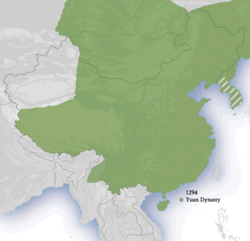
The Yuan dynasty under Kublai Khan afterwards the conquest of Southern Song dynasty.
The Mongols apace enclosed Xiangyang and defeated any attempt to reinforce it past the Song.
After a siege that lasted several years, and with the help of Muslim artillery created by Iraqi engineers, the Mongols finally forced the city of Xiangyang to surrender. The dying Song dynasty sent its armies confronting the Mongols at Yehue under the incompetent chancellor Jia Sidao. Predictably, the battle was a disaster. Running out of troops and supplies, the Song court surrendered to the Mongols in 1276.
Many Han Chinese were enslaved in the procedure of the Mongols invasion of Cathay proper.[69] According to Japanese historian Sugiyama Masaaki (杉山正明) and Funada Yoshiyuki (舩田善之), at that place were also a certain number of Mongolian slaves endemic by Han Chinese during the Yuan dynasty. However, in that location is no evidence that Han Chinese, who were considered people of the bottom of Yuan society according to some researchers, suffered particularly roughshod corruption.[70] [71]
With the desire to rule all of Communist china, Kublai established the Yuan dynasty and became Emperor of China. However, despite the give up of the Vocal court, resistance of Song remnants remained. Chinese resistance lasted for a few more than years as Song loyalists organized themselves effectually a powerless boy emperor, blood brother to the last formal Vocal emperor. In an endeavour to restore the Vocal dynasty, several Song officials set a government in Guangdong, aboard ships of the vast Song navy, which still maintained over a thousand ships (which then carried the Song army, which had been forced by the Mongol army off of the state onto these Song warships). Realizing this, in 1279 Kublai sent his fleet to engage the Song fleet at the boxing of Yamen in the waters off of modernistic Hong Kong, winning a decisive victory in which the last Song Emperor Bing of Song and his loyal officials committed suicide. This was the last major military confrontation of the Mongol conquest of the Song in southern China.
However, members of the Song Imperial Family continued to alive in the Yuan dynasty like Emperor Gong of Song, Zhao Mengfu, and Zhao Yong. Zhao Mengfu painted at the Yuan court and was personally interviewed by Kublai Khan. This exercise was referred to as 二王三恪.
Historian Patricia Buckley Ebrey noted that the Mongol Yuan dynasty treated the Jurchen Jin dynasty the Mongols treated the Jurchen Wanyan majestic family unit harshly, totally butchering them past the hundreds too as the Tangut emperor of Western Xia when they defeated him earlier. However Patricia besides noted the Mongols were totally lenient on the Han Chinese Zhao royal family of the Southern Song explicitly unlike the Jurchens in the Jingkang incident, sparing both the Southern Vocal royals in the capital Hangzhou similar the Emperor Gong of Song and his female parent likewise as sparing the civilians within it and not sacking the city, allowing them to get about their normal business organisation, rehiring Southern Song officials. The Mongols did not take the southern Song palace women for themselves merely instead had Han Chinese artisans in Shangdu marry the palace women.[72] The Mongol emperor Kublai Khan even granted a Mongol princess from his ain Borjigin family as a married woman to the surrendered Han Chinese Southern Song Emperor Gong of Song and they fathered a son together named Zhao Wanpu.[73] [74]
Chinese resistance in Vietnam against the Mongols [edit]
The ancestors of the Trần clan originated from the province of Fujian and later migrated to Đại Việt under Trần Kinh (陳京 Chén Jīng), the ancestor of the Trần clan. Their descendants, the later rulers of Đại Việt who were of mixed-blooded descent after established the Trần dynasty, which ruled Vietnam (Đại Việt). Despite many intermarriages between the Trần and several members of the Lý dynasty alongside members of their imperial court as in the instance of Trần Lý[75] [76] and Trần Thừa,[77] some of the mixed-blooded descendants of the Trần dynasty and sure members of the clan were still capable of speaking Chinese such as when a Yuan dynasty envoy had a coming together with the Chinese-speaking Trần prince Trần Quốc Tuấn in 1282.[78] [79] [80] [81] [82] [83] [84]
Professor Liam Kelley noted that people from Song dynasty China like Zhao Zhong and Xu Zongdao fled to Tran dynasty ruled Vietnam after the Mongol invasion of the Vocal and they helped the Tran fight against the Mongol invasion. The ancestors of the Tran clan originated from the modern day province of Fujian as did the Daoist cleric Xu Zongdao who recorded the Mongol invasion and referred to them as "Northern bandits". He quoted the Đại Việt Sử Ký Toàn Thư which said "When the Song [Dynasty] was lost, its people came to u.s.a.. Nhật Duật took them in. There was Zhao Zhong who served as his personal guard. Therefore, among the accomplishments in defeating the Yuan [i.e., Mongols], Nhật Duật had the most."[85] [86] The Tran defeated the Mongol invasions of Vietnam.
Southern Song Chinese war machine officers and noncombatant officials left to overseas countries, went to Vietnam and intermarried with the Vietnamese ruling elite and went to Champa to serve the government there as recorded by Zheng Sixiao.[87] Southern Song soldiers were function of the Vietnamese army prepared by emperor Trần Thánh Tông confronting the 2d Mongol invasion.[88]
Tactics and policies [edit]
During their campaigns, the Mongol Empire recruited many nationalities in their warfare, such as those of Primal and Eastern asia.[89] [xc] [91] [92] [93] The Mongols employed Chinese troops,[94] especially those who worked catapults and gunpowder to assist them in other conquests. In addition to Chinese troops, many scholars and doctors from Prc accompanied Mongol commanders to the west. The Mongols valued people with specialized skills.
The ability to make cast iron which was tough plenty for shooting objects with gunpowder was bachelor to the Chinese in the Song dynasty and information technology was adopted past the Liao, Jin, and Yuan dynasties.[95]
During the invasion of Transoxiana in 1219, along with the main Mongol force, Genghis Khan used a Chinese specialist catapult unit in battle. They were used in Transoxania again in 1220. The Chinese may have used the catapults to hurl gunpowder bombs, since they already had them past this fourth dimension[96] (although there were other siege engineers and technologies used in the campaigns, also.[97]) While Genghis Khan was acquisition Transoxania and Central Asia, several Chinese who were familiar with gunpowder were serving with Genghis's army.[98] "Whole regiments" entirely made out of Chinese were used past the Mongols to command bomb hurling trebuchets during the invasion of Iran.[99] Historians have suggested that the Mongol invasion had brought Chinese gunpowder weapons to Central Asia. I of these was the huochong, a Chinese mortar.[100] Books written around the expanse afterward depicted the use of gunpowder weapons which resembled that of Red china.[101]
One thousand northern Chinese engineer squads accompanied the Mongol Hulagu Khan during his conquest of the Middle Eastward.[102] [103] 1,000 Chinese participated in the Siege of Baghdad (1258).[104] [105] The Chinese Full general Guo Kan was one of the commanders during the siege and appointed Governor of Baghdad later the city was taken.[106] [107] [108] [109] [110]
While serving in the Mongol armies, Chinese generals were able to observe the invasion of West Asia.[111]
Co-ordinate to Ata-Malik Juvayni during the assail on the Alamut Assassins fort, "Khitayan" built siege weapons resembling crossbows were used.[112] [113] [114] "Khitayan" meant Chinese and it was a type of arcuballista, deployed in 1256 under Hulagu'southward command.[115] Stones were knocked off the castle and the bolts "burnt" a great number of the Assassins. They could fire a distance around 2,500 paces.[116] The device was described as an ox's bow.[117] Pitch which was lit on burn was practical to the bolts of the weapon earlier firing.[118] Some other historian thinks that instead gunpowder might have been strapped onto the bolts which caused the burns during the battle recorded by Juvayini.[119]
Alans were recruited into the Mongol forces with one unit called "Correct Alan Guard" which was combined with "recently surrendered" soldiers, Mongols, and Chinese soldiers stationed in the expanse of the former Kingdom of Qocho and in Besh Balikh the Mongols established a Chinese armed forces colony led by Chinese full general Qi Kongzhi (Ch'i Kung-chih).[120]
Against the Alans and the Cumans (Kipchaks), the Mongols used divide and conquer tactics: first the Mongols told the Cumans to stop allying with the Alans and and then, after the Cumans followed their proposition, the Mongols defeated the Alans[121] and and then attacked the Cumans.[122] Alan and Kipchak guards were used by Kublai Khan.[123] In 1368 at the end of the Yuan dynasty in China Toghan Temür was accompanied by his faithful Alan guards.[124] "Mangu enlisted in his bodyguard one-half the troops of the Alan prince, Arslan, whose younger son Nicholas took a part in the trek of the Mongols confronting Karajang (Yunnan). This Alan imperial guard was still in existence in 1272, 1286 and 1309, and information technology was divided into two corps with headquarters in the Ling pei province (Karakorúm)."[125] Alans were converted to Roman Catholic Christianity as were Armenians in China past John of Montecorvino.
Siege strategy [edit]
James Waterson cautioned confronting attributing the population driblet in northern China to Mongol slaughter since much of the population may have moved to southern China nether the Southern Song or died of disease and famine as agricultural and urban city infrastructure were destroyed.[126] The Mongols spared cities from massacre and sacking if they surrendered, like Kaifeng which was surrendered to Subetai past Xu Li,[127] Yangzhou, which was surrendered to Bayan by Li Tingzhi's second in control after Li Tingzhi was executed past the Southern Song,[128] and Hangzhou, which was spared from sacking when information technology surrendered to Kublai Khan.[129] Han Chinese and Khitan soldiers defected en masse to Genghis Khan against the Jurchen Jin dynasty.[130] Towns which surrendered were spared from sacking and massacre past Kublai Khan.[131] The Khitan reluctantly left their homeland in Manchuria as the Jin moved their primary uppercase from Beijing south to Kaifeng and defected to the Mongols.[132]
See besides [edit]
- Conquest dynasty
- Mongol conquest of the Qara Khitai
- Mongol invasions of Tibet
References [edit]
Citations [edit]
- ^ "Republicanchina.org Updates". world wide web.imperialchina.org.
- ^ Hugh D. Walker "Traditional Sino-Korean Diplomatic Relations : A Realistic Historical Appraisal", Monumenta Serica, Vol. 24 (1965), pp. 155–xvi, (p.159)
- ^ a b c d May, Timothy (2012). The Mongol Conquests in World History. London: Reaktion Books. p. 1211. ISBN9781861899712.
- ^ C. P. Atwood Encyclopedia of Mongolia and the Mongol Empire, p.590
- ^ a b de Hartog, Leo (2004). Genghis Khan: Conqueror of the World. New York City: I.B. Tauris. p. 59. ISBN1860649726.
- ^ J. Bor Mongol hiigeed Eurasiin diplomat shashtir, vol.2, p.204
- ^ Rossabi, William (2009). Genghis Khan and the Mongol empire. Seattle: University of Washington Printing. p. 156. ISBN978-9622178359.
- ^ Jack Weatherford Genghis Khan and the Making of the Modern World, p.85
- ^ Man, John (2004). Genghis Khan: Life, Decease, and Resurrection. New York City: St. Martin'due south Printing. p. 133. ISBN9780312366247.
- ^ a b Kohn, George C. (2007). Dictionary of Wars (3rd ed.). New York City: Infobase Publishing. p. 205. ISBN9781438129167.
- ^ Human, John (2004). Genghis Khan: Life, Death, and Resurrection. New York Urban center: St. Martin's Press. p. 160. ISBN9780312366247.
- ^ a b c Ebrey, Patricia Buckley (2012). Eastern asia: A Cultural, Social, and Political History (tertiary ed.). Stamford, Connecticut: Cengage Learning. p. 199. ISBN9781133606475.
- ^ Emmons, James B. (2012). "Genghis Khan". In Li, Xiaobing (ed.). China at State of war: An Encyclopedia. Santa Barbara, California: ABC-CLIO. p. 139. ISBN9781598844153.
- ^ Man, John (2004). Genghis Khan: Life, Death, and Resurrection. New York City: St. Martin'south Printing. p. 212. ISBN9780312366247.
- ^ Mote, Frederick W. (1999). Imperial China: 900–1800. Cambridge, Massachusetts: Harvard University Press. pp. 255–256. ISBN0674012127.
- ^ Man, John (2004). Genghis Khan: Life, Death, and Resurrection. New York Metropolis: St. Martin's Press. pp. 212–213. ISBN9780312366247.
- ^ Man, John (2004). Genghis Khan: Life, Death, and Resurrection. New York City: St. Martin's Press. p. 213. ISBN9780312366247.
- ^ a b Human, John (2004). Genghis Khan: Life, Death, and Resurrection. New York City: St. Martin'due south Press. p. 214. ISBN9780312366247.
- ^ Hartog 2004, pg. 134
- ^ Tucker, Spencer C., ed. (2010). A Global Chronology of Disharmonize: From the Ancient World to the Modern Eye E: From the Ancient World to the Modern Center E. Santa Barbara, California: ABC-CLIO. p. 276. ISBN978-1851096725.
- ^ de Hartog, Leo (2004). Genghis Khan: Conqueror of the Earth. New York Metropolis: I.B. Tauris. p. 135. ISBN1860649726.
- ^ Man, John (2004). Genghis Khan: Life, Death, and Resurrection. New York Urban center: St. Martin'due south Press. p. 219. ISBN9780312366247.
- ^ Man, John (2004). Genghis Khan: Life, Decease, and Resurrection. New York City: St. Martin's Press. pp. 219–220. ISBN9780312366247.
- ^ a b c de Hartog, Leo (2004). Genghis Khan: Conqueror of the World. New York City: I.B. Tauris. p. 137. ISBN1860649726.
- ^ Lange, Brenda (2003). Genghis Khan. New York City: Infobase Publishing. p. 71. ISBN9780791072226.
- ^ Homo, John (2004). Genghis Khan: Life, Death, and Resurrection. New York City: St. Martin's Press. p. 238. ISBN9780312366247.
- ^ Sinor, D.; Shimin, Geng; Kychanov, Y. I. (1998). Asimov, Yard. S.; Bosworth, C. E. (eds.). The Uighurs, the Kyrgyz and the Tangut (Eighth to the Thirteenth Century). Age of Achievement: A.D. 750 to the Terminate of the Fifteenth Century. Vol. 4. Paris: UNESCO. p. 214. ISBN9231034677.
- ^ Mote, Frederick W. (1999). Imperial China: 900–1800. Cambridge, Massachusetts: Harvard University Printing. p. 256. ISBN0674012127.
- ^ Boland-Crewe, Tara; Lea, David, eds. (2002). The Territories of the People's Republic of China. London: Europa Publications. p. 215. ISBN9780203403112.
- ^ May, Timothy (2016). May, Timothy (ed.). The Mongol Empire: A Historical Encyclopedia [two volumes]: A Historical Encyclopedia (illustrated, annotated ed.). ABC-CLIO. p. 81. ISBN978-1610693400.
- ^ Collectif 2002, p. 147.
- ^ "Archived re-create". Archived from the original on March four, 2016. Retrieved Jan 28, 2016.
{{cite web}}: CS1 maint: archived copy equally title (link) - ^ "白话元史-刘伯林传(附刘黑马传)". world wide web.wenxue100.com.
- ^ ""万户路"、"千户州"——蒙古千户百户制度与华北路府州郡体制 - 中国人民大学清史研究所".
- ^ May 2004, p. l.
- ^ http://123.125.114.20/view/ca3dae260722192e4536f629.html?re=view [ permanent dead link ]
- ^ http://121.199.12.114:99/primary/wz_xs.tom?c_name=%CF%F4%D7%D3%CF%D4&d_id=wzadd20120314102439zw&searh_text=
- ^ 豆丁网. "【doc】-兼论金元之际的汉地七万户". docin.org. Archived from the original on June 29, 2017. Retrieved January 10, 2016.
- ^ Schram 1987, p. 130.
- ^ eds. Seaman, Marks 1991, p. 175.
- ^ "窝阔台汗己丑年汉军万户萧札剌考辨--兼论金元之际的汉地七万户". www.wanfangdata.com.cn (in Chinese). Retrieved Jan 31, 2019.
- ^ "窝阔台汗己丑年汉军万户萧札剌考辨--兼论金元之际的汉地七万户-国家哲学社会科学学术期刊数据库". world wide web.nssd.org (in Chinese).
- ^ "新元史/卷146 – 維基文庫,自由的圖書館". Wikisource (in Traditional Chinese). Retrieved January 31, 2019.
- ^ "Archived copy". Archived from the original on March 4, 2016. Retrieved May 3, 2016.
{{cite web}}: CS1 maint: archived copy as title (link) - ^ Chan, Hok-Lam. 1997. "A Recipe to Qubilai Qa'an on Governance: The Case of Chang Te-hui and Li Chih". Periodical of the Royal Asiatic Society 7 (2). Cambridge University Press: 257–83. https://www.jstor.org/stable/25183352.
- ^ David Yard. Robinson (2009). Empire'due south Twilight: Northeast Asia Under the Mongols. Harvard Academy Press. pp. 24–. ISBN978-0-674-03608-6.
- ^ a b ed. de Rachewiltz 1993, p. 41.
- ^ Kinoshita 2013, p. 47.
- ^ Watt 2010, p. 14.
- ^ Kinoshita 2013, p. 47.
- ^ de Rachewiltz, Igor, ed. (1993). In the Service of the Khan: Eminent Personalities of the Early on Mongol-Yüan Menses (1200–1300). Otto Harrassowitz Verlag. pp. 27–45. ISBN978-3-447-03339-8.
- ^ Wang, Jinping (2020). In the Wake of the Mongols: The Making of a New Social Order in North China, 1200–1600. Harvard University Studies in Due east Asian Law. BRILL. p. 2, 9, 19, 50, 62, 68, 134. ISBN978-1684171002.
- ^ May, Timothy (2016). May, Timothy (ed.). The Mongol Empire: A Historical Encyclopedia [2 volumes]: A Historical Encyclopedia (illustrated, annotated ed.). ABC-CLIO. p. 82. ISBN978-1610693400.
- ^ Shinno, Reiko (2016). "2 The Mongol conquest and the new configuration of ability, 1206-76". The Politics of Chinese Medicine Under Mongol Rule. Needham Research Institute Series (illustrated ed.). Routledge. pp. 24–29. ISBN978-1317671602.
- ^ John Man Kublai Khan, p.79
- ^ C. P. Atwood Encyclopedia of Mongolia and the Mongols, p.613
- ^ Anderson, James A.; Whitmore, John K. (2014). Prc's Encounters on the South and Southwest: Reforging the Fiery Frontier Over Two Millennia (reprint, revised ed.). BRILL. p. 146. ISBN978-9004282483.
- ^ Dillon, Michael (1999). People's republic of china's Muslim Hui Customs: Migration, Settlement and Sects. Psychology Press. pp. 33, 34. ISBN0700710264.
- ^ Herman, John. Eastward. (2005). Di Cosmo, Nicola; Wyatt, Don J (eds.). Political Frontiers, Indigenous Boundaries and Human Geographies in Chinese History (illustrated ed.). Routledge. p. 260. ISBN1135790957.
- ^ Crossley, Pamela Kyle; Siu, Helen F.; Sutton, Donald Due south., eds. (2006). Empire at the Margins: Civilization, Ethnicity, and Frontier in Early Modern China. Vol. 28 of Studies on People's republic of china (illustrated ed.). Academy of California Press. p. 143. ISBN0520230159.
- ^ Smith, John Masson Jr. (January–March 1998). "Review: Nomads on Ponies vs. Slaves on Horses". Journal of the American Oriental Society. American Oriental Society. 118 (1): 54–62. doi:10.2307/606298. JSTOR 606298.
- ^ Yang, Bin (2009). "Chapter 4 Rule Based on Native Customs". Betwixt winds and clouds: the making of Yunnan (second century BCE to twentieth century CE). Columbia Academy Press. p. 112. ISBN978-0231142540. Alt URL
- ^ David Nicolle; Richard Hook (1998). The Mongol Warlords: Genghis Khan, Kublai Khan, Hulegu, Tamerlane (illustrated ed.). Brockhampton Press. p. 57. ISBNone-86019-407-nine . Retrieved November 28, 2011.
For his part Kublai defended himself totally to the chore, but it was still to be the Mongol'due south thoughest war. The Sung Chinese showed themselves to be the nigh resilient of foes. Southern China was not only densely populated and full of strongly walled cities. It was too a land of mountain ranges and broad fast-flowing
- ^ L. Carrington Goodrich (2002). A Short History of the Chinese People (illustrated ed.). Courier Dover Publications. p. 173. ISBN0-486-42488-10 . Retrieved November 28, 2011.
Unquestionably in the Chinese the Mongols encountered more stubborn opposition and better defense force than any of their other opponents in Europe and Asia had shown. They needed every military artifice known at that time, for they had to fight in terrain that was difficult for their horses, in regions infested with diseases fatal to big numbers of their forces, and in boats to which they were not accustomed.
- ^ Hucker 1985, p.66.
- ^ Robinson, David M. (2009). "i. Northeast Asia and the Mongol Empire". Empire'southward Twilight: Northeast Asia Under the Mongols (illustrated ed.). Cambridge, Massachusetts, United states of america: Harvard University Press. p. 52. ISBN978-0674036086.
- ^ Homo, John (2012). Kublai Khan (reprint ed.). Random House. p. 168. ISBN978-1446486153.
- ^ Cheung, Ming Tai (2001). China's Entrepreneurial Army (illustrated, reprint ed.). Oxford Academy Press. p. 14. ISBN0199246904.
- ^ Junius P. Rodriguez, "The Historical Encyclopedia of World Slavery", ABC-CLIO, 1997, pp146
- ^ 杉山正明《忽必烈的挑战》,社会科学文献出版社,2013年,第44–46頁
- ^ 船田善之《色目人与元代制度、社会--重新探讨蒙古、色目、汉人、南人划分的位置》,〈蒙古学信息〉2003年第2期
- ^ Ebrey, Patricia Buckley (2016). "ix State-Forced Relocations in China, 900-1300 THE MONGOLS AND THE STATE OF YUAN". In Ebrey, Patricia Buckley; Smith, Paul Jakov (eds.). Land Power in China, 900-1325 (illustrated ed.). University of Washington Press. pp. 325, 326. ISBN978-0295998480. Archived from the original on June 13, 2021.
- ^ Hua, Kaiqi (2018). "Affiliate 6 The Journey of Zhao Xian and the Exile of Royal Descendants in the Yuan Dynasty (1271 1358)". In Heirman, Ann; Meinert, Carmen; Anderl, Christoph (eds.). Buddhist Encounters and Identities Beyond East asia. Leiden, Netherlands: BRILL. p. 213. doi:10.1163/9789004366152_008. ISBN978-9004366152.
- ^
- ^ "Ham sắc, Tô Trung Từ tự hại mình". Retrieved March 9, 2017.
- ^ "Nhà Trần khởi nghiệp". Retrieved March nine, 2016.
- ^ Chapuis, Oscar (1995). A history of Vietnam: from Hong Blindside to Tu Duc. Greenwood Press. p. 85. ISBN0-313-29622-7.
- ^ Taylor, K. W. (2013). A history of the Vietnamese (1. publ. ed.). Cambridge: Cambridge University Printing. pp. 103, 120. ISBN978-0521699150.
- ^ 1000. West. Taylor (May 9, 2013). A History of the Vietnamese. Cambridge Academy Press. pp. 120–. ISBN978-0-521-87586-viii.
- ^ Hall, Kenneth R., ed. (2008). Secondary cities and urban networking in the Indian Ocean Realm, c. 1400–1800. Lanham: Lexington Books. pp. 159–. ISBN978-0-7391-2835-0.
- ^ Jayne Werner; John K. Whitmore; George Dutton (August 21, 2012). Sources of Vietnamese Tradition. Columbia University Press. pp. 29–. ISBN978-0-231-51110-0.
- ^ Geoffrey C. Gunn (August ane, 2011). History Without Borders: The Making of an Asian World Region, one thousand–1800. Hong Kong University Press. pp. 112–. ISBN978-988-8083-34-3.
- ^ Ainslie Thomas Embree; Robin Jeanne Lewis (1988). Encyclopedia of Asian history. Scribner. p. 190. ISBN9780684189017. p. 190.
- ^ Alexander Woodside (1971). Vietnam and the Chinese Model: A Comparative Study of Vietnamese and Chinese Government in the Starting time Half of the Nineteenth Century. Harvard Univ Asia Center. pp. 8–. ISBN978-0-674-93721-5.
- ^ "Giặc Bắc đến xâm lược!: Translations and Exclamation Points". wordpress.com. December 4, 2015. Archived from the original on October half-dozen, 2016. Retrieved Apr v, 2016.
- ^ "Liam Kelley – Department of History". Oct 14, 2014. Archived from the original on October fourteen, 2014.
- ^ Anderson, James A.; Whitmore, John K. (2014). People's republic of china's Encounters on the South and Southwest: Reforging the Fiery Borderland Over 2 Millennia (reprint, revised ed.). BRILL. p. 122. ISBN978-9004282483.
- ^ Anderson, James A.; Whitmore, John K. (2014). China's Encounters on the South and Southwest: Reforging the Fiery Borderland Over Two Millennia (reprint, revised ed.). BRILL. p. 123. ISBN978-9004282483.
- ^ Reuven Amitai-Preiss Mongols and Mamluks: The Mamluk-Ilkhanid State of war, 1260–1281 p. 189
- ^ Angus Donal Stewart The Armenian kingdom and the Mamluks, p. 54
- ^ Michael Biran The empire of the Qara Khitai in Eurasian history: between China and the Islam, p.143
- ^ Stepehen Turnball The Mongol Invasions of Japan 1274 and 1281, p.72
- ^ Peter Jackson The Mongols and the West, p.86
- ^ Morris Rossabi (November 28, 2014). From Yuan to Modernistic China and Mongolia: The Writings of Morris Rossabi. BRILL. pp. 443–. ISBN978-90-04-28529-3.
- ^ HAW, STEPHEN K. (July 2013). "The Mongol Empire – the showtime 'gunpowder empire'?". Journal of the Royal Asiatic Society. 23 (iii): 444–451. doi:10.1017/S1356186313000369. S2CID 162200994.
- ^ Kenneth Warren Chase (2003). Firearms: a global history to 1700 (illustrated ed.). Cambridge University Press. p. 58. ISBN0-521-82274-two . Retrieved November 28, 2011.
Chinggis Khan organized a unit of Chinese catapult specialists in 1214, and these men formed part of the outset Mongol army to invade Transoania in 1219. This was not too early on for true firearms, and information technology was nearly two centuries after catapult-thrown gunpowder bombs had been added to the Chinese arsenal. Chinese siege equipment saw action in Transoxania in 1220 and in the north Caucasus in 1239–40.
- ^ The Devil'due south Horsemen: The Mongol Invasion of Europe by James Chambers, p.71
- ^ David Nicolle; Richard Hook (1998). The Mongol Warlords: Genghis Khan, Kublai Khan, Hulegu, Tamerlane (illustrated ed.). Brockhampton Press. p. 86. ISBNone-86019-407-9 . Retrieved November 28, 2011.
Though he was himself a Chinese, he learned his trade from his father, who had accompanied Genghis Khan on his invasion of Muslim Transoxania and Iran. Perhaps the use of gunpowder every bit a propellant, in other words the invention of true guns, appeared showtime in the Muslim Eye E, whereas the invention of gunpowder itself was a Chinese achievement
- ^ Arnold Pacey (1991). Applied science in world civilisation: a grand-year history (reprint, illustrated ed.). MIT Press. p. 46. ISBN0-262-66072-5 . Retrieved November 28, 2011.
During the 1250s, the Mongols invaded Iran with 'whole regiments' of Chinese engineers operating trebuchets (catapults) throwing gunpowder bombs. Their progress was rapid and devastating until, after the sack of Baghdad in 1258, they entered Syria. There they met an Islamic regular army similarly equipped and experienced their first defeat. In 1291, the same sort of weapon was used during the siege of Acre, when the European Crusaders were expelled form Palestine.
- ^ Chahryar Adle; Irfan Habib (2003). Ahmad Hasan Dani; Chahryar Adle; Irfan Habib (eds.). History of Civilizations of Central Asia: Development in dissimilarity : from the sixteenth to the mid-nineteenth century. Vol. v (illustrated ed.). UNESCO. p. 474. ISBN92-3-103876-1 . Retrieved November 28, 2011.
Indeed, information technology is possible that gunpowder devices, including Chinese mortar (huochong), had reached Central Asia through the Mongols as early equally the thirteenth century.71 Nevertheless the potential remained unexploited; even Sultan Husayn's utilise of cannon may accept had Ottoman inspiration.
- ^ Arnold Pacey (1991). Technology in world civilization: a thousand-year history (reprint, illustrated ed.). MIT Press. p. 46. ISBN0-262-66072-v . Retrieved November 28, 2011.
The presence of these individuals in China in the 1270s, and the deployment of Chinese engineers in Iran, mean that there were several routes by which information about gunpowder weapons could laissez passer from the Islamic earth to China, or vice versa. Thus when two authors from the eastern Mediterranean region wrote books about gunpowder weapons around the year 1280, it is non surprising that they described bombs, rockets and fire-lances very similar to some types of Chinese weaponry.
- ^ Josef Westward. Meri (2005). Josef W. Meri (ed.). Medieval Islamic Civilization: An Encyclopedia. Psychology Press. p. 510. ISBN0-415-96690-six . Retrieved November 28, 2011.
This called for the employment of engineers to engaged in mining operations, to build siege engines and artillery, and to concoct and use incendiary and explosive devices. For case, Hulagu, who led Mongol forces into the Middle East during the second wave of the invasions in 1250, had with him a thousand squads of engineers, obviously of north Han Chinese (or perhaps Khitan) provenance.
- ^ Josef Due west. Meri; Jere L. Bacharach (2006). Josef Due west. Meri; Jere L. Bacharach (eds.). Medieval Islamic Civilization: L-Z, index. Vol. ii (illustrated ed.). Taylor & Francis. p. 510. ISBN0-415-96692-2 . Retrieved November 28, 2011.
This called for the employment of engineers to engaged in mining operations, to build siege engines and artillery, and to contrive and use incendiary and explosive devices. For example, Hulagu, who led Mongol forces into the Middle Due east during the 2d wave of the invasions in 1250, had with him a yard squads of engineers, manifestly of north Chinese (or perhaps Khitan) provenance.
- ^ Lillian Craig Harris (1993). China considers the Middle East (illustrated ed.). Tauris. p. 26. ISBN1-85043-598-vii . Retrieved June 28, 2010.
- ^ Gloria Skurzynski (2010). This Is Rocket Science: Truthful Stories of the Risk-Taking Scientists Who Figure Out Ways to Explore Beyond Earth (illustrated ed.). National Geographic Books. p. 1958. ISBN978-ane-4263-0597-9 . Retrieved November 28, 2011.
In A.D. 1232 an army of 30,000 Mongol warriors invaded the Chinese city of Kai-fung-fu, where the Chinese fought back with burn down arrows ... Mongol leaders learned from their enemies and constitute ways to make burn arrows even more deadly as their invasion spread toward Europe. On Christmas 24-hour interval 1241 Mongol troops used fire arrows to capture the metropolis of Budapest in Republic of hungary, and in 1258 to capture the metropolis of Baghdad in what's now Republic of iraq.
- ^ Colin A. Ronan (1995). The Shorter Scientific discipline and Culture in China. Vol. 5 (illustrated ed.). Cambridge University Printing. p. 250. ISBN0-521-46773-10 . Retrieved November 28, 2011.
Moreover, many Chinese were in the first moving ridge of the Mongolian conquest of Islamic republic of iran and Republic of iraq – a Han general, Guo Kan, was start governor of Baghdad after its capture in advertisement 1258. As the Mongols had a addiction of destroying irrigation and
- ^ Original from the University of Michigan Thomas Francis Carter (1955). The invention of printing in China and its spread westward (2 ed.). Ronald Press Co. p. 174. ISBN9780608113135 . Retrieved November 28, 2011.
The name of this Chinese full general was Kuo K'an (Mongol, Kuka Ilka). He commanded the right flank of the Mongol army in its advance on Baghdad and remained in accuse of the urban center after its surrender. His life in Chinese has been preserved
- ^ Thomas Francis Carter (1955). The invention of printing in China and its spread w (2 ed.). Ronald Press Co. p. 171. ISBN9780608113135 . Retrieved June 28, 2010.
Chinese influences presently made themselves strongly felt in Hulagu's dominions. A Han general was fabricated the beginning governor of Baghdad,five and Chinese engineers were employed to improve the irrigation of the Tigris-Euphrates basin
- ^ Jacques Gernet (1996). A history of Chinese civilization . Cambridge University Press. p. 377. ISBN0-521-49781-7 . Retrieved October 28, 2010.
- ^ Lillian Craig Harris (1993). China considers the Middle East (illustrated ed.). Tauris. p. 26. ISBN1-85043-598-7 . Retrieved June 28, 2010.
The offset governor of Baghdad under the new regime was Guo Kan, a Han general who had commanded the Mongols' correct flank in the siege of Baghdad. Irrigation works in the Tigris-Euphrates basin were improved by Chinese engineers
(Original from the University of Michigan) - ^ Hyunhee Park (Baronial 27, 2012). Mapping the Chinese and Islamic Worlds: Cross-Cultural Exchange in Pre-Modernistic Asia. Cambridge University Printing. pp. 126–. ISBN978-1-139-53662-2.
- ^ ʻAlā al-Dīn ʻAṭā Malek Joveynī (1958). The history of the Earth-Conqueror. Harvard Academy Press. p. 631.
- ^ Journal of Asian History. O. Harrassowitz. 1998. p. xx.
- ^ Mansura Haidar; Aligarh Muslim University. Center of Avant-garde Study in History (September 1, 2004). Medieval Fundamental Asia: polity, economy and military machine organization, fourteenth to sixteenth centuries. Manohar Publishers Distributors. p. 325. ISBN978-81-7304-554-7.
- ^ Wright, David Curtis (2008). Ferris, John (ed.). "NOMADIC POWER, SEDENTARY SECURITY, AND THE CROSSBOW". Calgary Papers in War machine and Strategic Studies. Military Studies and History. Middle for Armed forces and Strategic Studies. ii: 86. ISBN978-0-88953-324-0.
- ^
- ^ Wright, David C. "The Sung-Kitan War of A.D. 1004–1005 and the Treaty of Shan-Yüan." Journal of Asian History, vol. 32, no. 1, 1998, p. twenty. JSTOR 41933065.
- ^ Peter Willey (2001). The Castles of the Assassins. Linden Pub. p. 166. ISBN978-0-941936-64-iv.
- ^ Haw, Stephen 1000. (July 2013). "The Mongol Empire – the showtime 'gunpowder empire'?". Journal of the Purple Asiatic Society. 23 (3): 458. doi:10.1017/S1356186313000369. S2CID 162200994.
- ^ Morris Rossabi (1983). Cathay Among Equals: The Centre Kingdom and Its Neighbors, tenth–14th Centuries. University of California Press. pp. 255–. ISBN978-0-520-04562-0.
- ^ Halperin, Charles J.. 2000. "The Kipchak Connexion: The Ilkhans, the Mamluks and Ayn Jalut". Message of the School of Oriental and African Studies, University of London 63 (ii). Cambridge University Press: 235. JSTOR 1559539.
- ^ Sinor, Denis. 1999. "The Mingols in the West". Journal of Asian History, 33 (one). Harrassowitz Verlag: 1–44. JSTOR 41933117.
- ^ David Nicolle (January 2004). The Mongol Warlords: Genghis Khan, Kublai Khan, Hulegu, Tamerlane. Brockhampton Printing. p. 85. ISBN978-1-86019-407-viii.
- ^ Arthur Thomas Hatto (1991). Archivum Eurasiae Medii Aevi. Peter de Ridder Press. p. 36.
- ^ Henry Yule (1915). Red china and the Way Thither, Existence a Drove of Medieval Notices of China. Asian Educational Services. pp. 187–. ISBN978-81-206-1966-1.
- ^ Waterson, James (2013). Defending Sky: China'due south Mongol Wars, 1209-1370. Casemate Publishers. ISBN978-1783469437.
- ^ Waterson, James (2013). Defending Heaven: China's Mongol Wars, 1209-1370. Casemate Publishers. ISBN978-1783469437.
- ^ Waterson, James (2013). Defending Heaven: China's Mongol Wars, 1209-1370. Casemate Publishers. ISBN978-1783469437.
- ^ Balfour, Alan H.; Zheng, Shiling (2002). Balfour, Alan H. (ed.). Shanghai (illustrated ed.). Wiley-Academy. p. 25. ISBN0471877336.
- ^ Waterson, James (2013). Defending Heaven: Mainland china's Mongol Wars, 1209-1370. Casemate Publishers. ISBN978-1783469437.
- ^ Coatsworth, John; Cole, Juan Ricardo; Hanagan, Michael P.; Perdue, Peter C.; Tilly, Charles; Tilly, Louise (2015). Global Connections. Vol. ane of Global Connections: Politics, Exchange, and Social Life in World History (illustrated ed.). Cambridge Academy Printing. p. 356. ISBN978-0521191890.
- ^ Man, John (2013). Genghis Khan: Life, Death, and Resurrection. Macmillan. ISBN978-1466861565.
Sources [edit]
- Li Bo, Zheng Yin. 5000 years of Chinese history, Inner Mongolian People's publishing corp, 2001. ISBN seven-204-04420-7.
- Smith, John Masson Jr. (January–March 1998). "Review: Nomads on Ponies vs. Slaves on Horses". Journal of the American Oriental Society. American Oriental Club. 118 (one): 54–62. doi:10.2307/606298. JSTOR 606298.
- Wright, David Curtis. "Mongol conquest of Cathay," in Gordon Martel, ed., The Encyclopedia of State of war, First Edition (Hoboken, New Jersey: Blackwell Publishing Ltd, 2011).
Source: https://en.wikipedia.org/wiki/Mongol_conquest_of_China
0 Response to "What helped the Chinese to overthrow the Mongol rulers?"
Postar um comentário